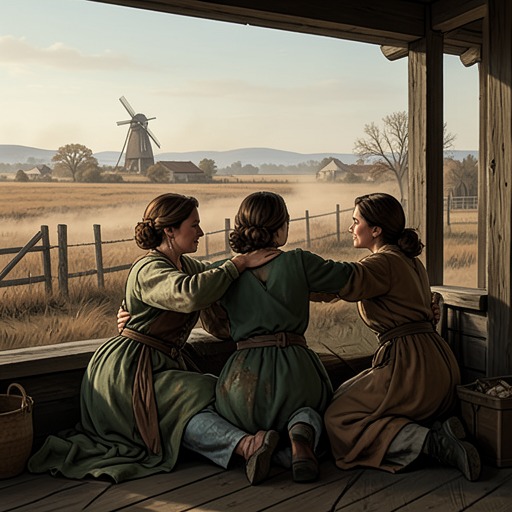
Mustang Prairie municipal government
It Must Be Love: A Mustang Prairie RomanceMustang Prairie municipal government is not merely a bureaucratic backdrop in the novel. Through City Hall, it converts the town’s limited public resources, informal trust networks, and civic leadership into tangible support for education, small business, and children in need. Its most important function is connective: it gives Trixie Beaumont permission, space, supplies, and collaborators, allowing her personal ambition to become part of Mustang Prairie’s shared life.
Civic Structure and Interim Leadership
Mustang Prairie municipal government operates from City Hall, where Eric is serving as Interim Mayor while the elected mayor, Charlie Withers, is on leave after his wife Mavis receives a cancer diagnosis. The temporary arrangement gives Eric practical authority over local requests, but it also places him in a visibly inherited and imperfect administrative structure. His assistant, Jayne Denver, presents a more conventional political image, while Eric himself is portrayed as approachable, informal, and still learning how to manage the office and its inherited personnel.
Trixie’s visit to City Hall shows how accessible this government can be. She walks from her apartment above Under the Skirt, crosses the street, and goes directly to the one official who can approve what she wants to do. The distance between her shop and City Hall is literal as well as institutional: her entrepreneurial plans do not have to pass through an impersonal chain of offices. They can be carried across the street and discussed face to face.
Supporting Trixie Beaumont’s Classes
The government’s clearest intervention is Eric’s approval of Trixie’s sewing and knitting class. Trixie has spent months imagining a clothing line, experimenting with names, sketching logos, and even contacting a graphic designer, yet the finished ideas have begun to mock her inaction. Her request for a class is therefore more than a civic proposal. It is the first concrete administrative step toward transforming a private dream into an operating enterprise.
Eric explains a simple process: his assistant will post an announcement on the town website once Trixie chooses a name for the class. She must pay a small room-rental fee and leave the space as she found it. The arrangement preserves municipal rules without burying the project in unnecessary obstacles. Trixie leaves City Hall with the unsettling realization that she is truly beginning. The government’s modest approval becomes a psychological threshold as well as a practical one.
The classes quickly outgrow their original room. After online registration reaches its limit, Eric informs Trixie that the group must move to a larger space with better lighting and more comfortable chairs. The change demonstrates that municipal support is responsive rather than purely ceremonial: the government adapts its facilities to actual public demand. Trixie’s teaching also becomes a community resource, drawing mothers and children into a shared activity and preparing residents to help with the costume drive.
The Costume Drive and Resource Mobilization
Eric proposes replacing a limited purchase of ready-made costumes with a larger supply of fabric and accessories. Rather than spending the budget on a fixed number of finished outfits and leaving other children without costumes, the municipal project buys materials from which residents can make wings, wands, capes, tiaras, and other costume elements. The policy turns money into collective labor and expands the number of children the program can reach.
The government also helps secure the material infrastructure for that labor. Trixie tells her Saturday knitting group that sewing machines promised by Eric may arrive in time for them to assist with the drive. Later, Eric reserves two large rooms containing eight sewing tables, a semicircle of chairs for knitting and hand sewing, a Glitter Station for decoration, and a snack table. The rooms are intended to be shared with the high school drama department when school resumes, linking municipal relief work with an existing educational and artistic institution.
The drive is designed as a town-wide gathering as much as a distribution program. Residents come for free food, conversation, and a party, while senior citizens are included by scheduling the event early enough for them to attend. The stated purpose is to give less fortunate children in Mustang Prairie a good Halloween, but the event also creates a setting in which many kinds of residents can contribute. City Hall supplies the structure; the town supplies the hands, attention, and social energy.
Trust, Oversight, and Local Networks
Municipal assistance is not presented as completely frictionless. When Trixie arrives to discuss supplies, Eric has arranged for another person to help her. Because she is responsible for handling money and is still relatively new to Mustang Prairie, she initially suspects that the arrangement reflects distrust. Her direct question exposes the emotional stakes behind administrative oversight: after her life with Preston, she has promised herself to ask plainly rather than silently accept other people’s assumptions.
Eric reassures her that he trusts her implicitly. He praises the weekend classes because local mothers have told him how much they enjoy them with their children, and because those participants are eager to help make costumes. He also explains that the additional assistance is connected to her injured foot. The moment clarifies the government’s relationship to Trixie: supervision exists, but it is joined to recognition of her contribution and concern for her physical limits.
The person Eric brings in is Jack Thorpe, introduced as Trixie’s “muscle for the day.” Eric’s decision draws a private relationship into a public task. Jack’s presence is not only logistical; it intensifies the unresolved attraction between him and Trixie. In this way, municipal work becomes a meeting point for personal and civic networks. Eric’s leadership relies on people whose connections extend beyond City Hall, while Trixie’s participation gives those networks new points of contact.
From Civic Project to Community Platform
The municipal spaces and programs eventually support an expanding chain of activity around Trixie’s lingerie business. Her classes help establish her practical authority, her store supplies the commercial foundation, and her new line, Sexy Separates by Trixie, develops through design, quality control, and local collaboration. Trixie works toward producing multiple styles of panties and bras in a range of colors so customers can mix and match rather than purchase only conventional matching sets. The project remains private business, but its development is inseparable from the town’s spaces and relationships.
As the line grows, Trixie uses the workshop next to Under the Skirt as a developing work area. She insists on retaining control over quality rather than immediately hiring a manufacturer, while Jonquil Spring helps rank seamstresses who might join the production process. This later stage reveals the limits of municipal involvement as well as its importance: City Hall does not run the company, but its earlier support has helped create the conditions in which Trixie can make independent decisions about labor, production, and scale.
The culmination is the lingerie launch at Dylan’s bar, where Sadie, Kiki Ramirez, and other models present Trixie’s designs on a makeshift runway. Although the show takes place outside City Hall, its communal logic resembles the costume drive: local people contribute performance, music, space, labor, and publicity. The municipal government’s role is therefore best understood as catalytic. It helps establish the civic habits—shared rooms, pooled materials, volunteered skills, and mutual recommendation—that later sustain a private creative enterprise.
Narrative Significance
Mustang Prairie municipal government represents a form of authority that works through participation rather than distance. Its rooms can be rented, its website can advertise a class, its budget can be redirected toward materials, and its officeholder can recruit residents to solve practical problems. The institution remains imperfect, shaped by an absent mayor, an inherited assistant, financial limits, and the need to justify how resources are used. Yet its effectiveness comes from permitting local initiative to circulate through a recognizable public structure.
The government’s significance lies especially in the way it joins commerce, care, and belonging. Trixie’s classes are connected to her lingerie line; the classes feed the costume drive; the drive brings together parents, children, seniors, the drama department, and volunteers; and the same community later helps make her brand visible. City Hall does not erase the boundary between public service and private ambition, but it allows them to reinforce one another. In Mustang Prairie, civic infrastructure becomes a social bridge through which a woman rebuilding her independence can find work, recognition, and a place in the town’s collective life.